
Why Mid-Sized Campus Venues Require a More Sophisticated Operating Model
As colleges build smaller, more flexible arenas, the challenge is no longer capacity; it is performance. Mid-sized arena management now plays a critical role in activation, alignment, and long-term value.
For much of the past several decades, the defining question in collegiate arena development centered on scale. Institutions often equated larger venues with greater visibility, stronger athletics programs, and long-term growth potential. Capacity served as a proxy for ambition.
That model is starting to change. Colleges are placing more emphasis on flexibility, experience, and long-term performance when planning new arenas. Recent industry reporting points to the same trend. There is a growing emphasis on premium seating, flexible design, and venues that support both athletics and broader campus use. Coverage in Athletic Business highlights the move toward multi-use environments. At the same time, Sports Business Journal points to increased investment in premium and fan-focused experiences as central to modern venue strategy.
The Shift Toward Smaller, More Flexible Campus Arenas
This shift is happening alongside a renewed wave of investment in collegiate athletics facilities. An HVS analysis of completed stadium projects indicates that total value reached approximately $2.4 billion in 2025, with projections exceeding $3 billion in 2026. Arena development is also accelerating, with 2025 surpassing $1 billion in total arena projects and 27 new college arenas opening that year. This scale of investment underscores both the pace of development and the expectations tied to long-term performance.
Mid-sized arenas have emerged as a practical and increasingly common model within collegiate athletics. These venues are designed to support Division I competition while also accommodating regional events and campus programming. Industry reporting highlights a growing emphasis on flexibility and multi-use design, with facilities expected to serve both institutional and community needs. In addition, right-sized venues can create more consistent energy and stronger utilization than larger buildings that are not regularly filled.
This is already playing out on campuses. At CENTERS-managed venues, institutions are working through these questions in real time, aligning facility design with operating models that can support consistent use and multiple stakeholders.
Why Right-Sized Arenas Still Struggle with Utilization
Despite their advantages, many mid-sized arenas continue to be managed as extensions of athletics or campus recreation. This approach supports core functions such as game-day execution and internal scheduling. However, it often falls short of addressing the full potential of the venue.
A collegiate arena hosts a limited number of athletic events each year. The remaining calendar presents significant opportunity. Many institutions lack a structured approach to activating those dates. Coverage in the Sports Business Journal has highlighted that colleges are increasingly expected to monetize and program their facilities beyond athletics alone.
There is also an experiential dimension to this challenge. In venues that are not consistently filled or activated, the impact is visible. A half-utilized arena can reduce the energy of a game-day environment. It can affect how events are experienced by students, fans, and prospective recruits. By contrast, right-sized venues that are consistently programmed tend to create stronger and more engaging environments. This reinforces both athletics performance and institutional perception.
At the same time, broader institutional pressures are intensifying the need for performance. Research from NACUBO points to rising operating costs, workforce challenges, and growing expectations around demonstrating the value of institutional assets. Facilities are central to that equation, placing additional pressure on institutions to ensure that major investments are fully utilized and aligned with institutional priorities.
More buildings are being designed for flexibility and expanded use. Operations often remain narrowly focused. Without a deliberate strategy, institutions risk underutilizing assets that were intended to play a much larger role.
From Facilities Management to Venue Activation Strategy
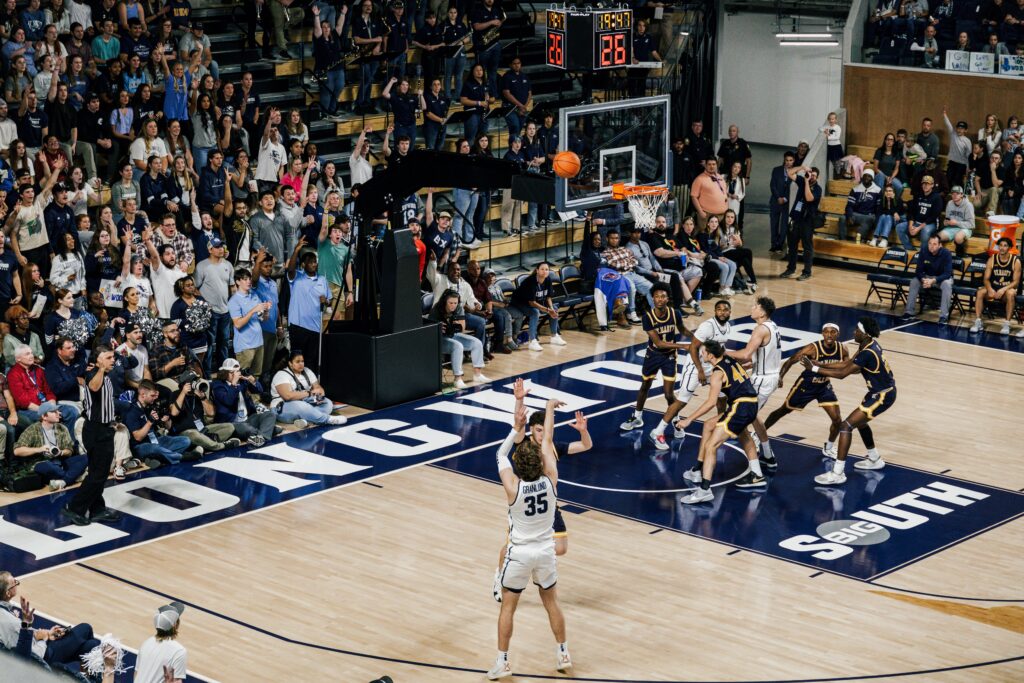 Institutions that are realizing greater value from their arenas are approaching them differently. Institutions no longer manage these buildings solely as facilities to be maintained. They are being positioned as active venues, with an emphasis on programming, engagement, and sustained use over time.
That requires a more intentional operating model. It includes identifying and securing external events, building relationships with promoters and community partners, and positioning the venue within a broader regional market. It also depends on systems that can support a wide range of uses, from athletics competitions to concerts and civic events, often within tight timeframes.
The Joan Perry Brock Center at Longwood University reflects this direction. Designed to elevate the fan and student experience, the arena creates a more intimate and consistently filled environment for Division I basketball. That atmosphere strengthens the home-court experience and contributes to increased visibility for the program, including more frequent national broadcasts.
At the same time, delivering that level of activity requires coordination across multiple stakeholders. Athletics, student affairs, and external partners often bring different priorities, and aligning those interests requires clear structure and operating discipline. At CENTERS-managed venues, this type of coordination has become routine. Calendars are built around a mix of athletics, campus programming, and external events, with rapid transitions between uses. The result is a more consistent level of activity and a venue that functions as a true campus and community asset.
How Outsourced Arena Management Expands Institutional Capacity
As expectations grow, many institutions are taking a closer look at whether their current operating structures can keep pace. The question is straightforward. Can the existing model support the level of activity these venues are now expected to deliver?
For some, the answer has been to look beyond traditional in-house approaches. In this context, outsourcing is less about cost and more about capability. It brings a level of focus and experience that can be difficult to build internally, particularly for venues that must balance athletics, campus use, and external programming.
A dedicated operating partner can provide expertise in multi-use scheduling, event booking, and revenue strategy, along with systems designed to support a steady flow of activity. These capabilities help move a venue from periodic use to consistent activation, especially when events must shift quickly between athletics, campus programming, and external use.
This thinking aligns with broader trends in campus asset strategy. Research from firms such as JLL points to a more proactive approach to managing facilities, with institutions increasingly using partnerships to improve utilization and overall performance.
For mid-sized arenas, this model can be especially relevant. Larger venues often justify fully specialized internal teams. Smaller arenas rarely do, even as expectations remain just as high. Many are located in regional markets where attracting consistent programming requires both local understanding and industry relationships.
That is where fit matters. National operators are often structured around scale and major markets. Mid-sized collegiate arenas require a different approach. Institutions benefit from partners who understand the higher education environment, can navigate campus priorities, and bring the same level of attention and strategy to venues that may not be the largest in the market, but are central to the campus experience. At the Joan Perry Brock Center at Longwood University, this approach supports both the day-to-day athletics environment and a broader mix of campus and community use.
Why Mid-Sized Venues Require a Higher Level of Collaboration
The complexity of operating a mid-sized arena is often underestimated. These venues must deliver a high-quality athletics environment while also functioning as flexible event spaces and community assets. Each role brings different operational demands, and balancing them requires coordination that extends beyond traditional facility management.
Those expectations are shaped in part by broader pressures facing higher education. Institutions are operating in an increasingly competitive environment, with greater emphasis on the overall campus experience and how they differentiate themselves.
In that context, institutions now expect facilities to play a more visible role. They contribute to recruitment, support institutional identity, and create points of connection with the surrounding community. When a venue is inconsistently programmed or operationally inefficient, the impact goes beyond lost revenue. It can influence how the campus is experienced and how the institution is viewed.
Aligning Arena Operations with Institutional Mission and Community Impact
Mid-sized arenas often serve both the campus and the surrounding community. They host athletics, institutional events, and public programming, which brings a wider set of expectations.
Meeting those expectations requires more than scheduling. Institutions must balance access, pricing, and programming across different audiences while coordinating across athletics, student affairs, and external partners.
In that environment, the operating model carries real weight. Success is not measured only by revenue or event volume, but by how well the venue supports the broader goals of the institution.
Rethinking Arena Operations as a Strategic Imperative
The move toward smaller, more flexible arenas reflects a broader change in how institutions think about facility investment. Institutions design these venues to be adaptable and aligned with current demand, but design alone does not guarantee performance.
What matters is how the building is used over time. For many institutions, that has become the central question. Not how large the arena is, but whether it is consistently active, well-programmed, and fully integrated into campus and community life.
Those outcomes do not happen on their own. They depend on the systems, expertise, and coordination required to keep the venue active across a wide range of uses.
Institutions that get this right will see the difference. Not just in revenue or utilization, but in the role these venues play in shaping the campus experience and how the institution is perceived.
Sources & Further Reading
- “Higher Education Trends to Watch.” JLL,
https://www.jll.com/en-us/insights/higher-education-trends-to-watch
- “How the NIL Era Is Reshaping Stadium Development.” HVS, 2025,
https://www.hvs.com/article/10315-how-the-nil-era-is-reshaping-stadium-development
- “Matchday Momentum: The New Playbook for College Tennis.” Athletic Business,
https://www.athleticbusiness.com/facilities/article/15747171/matchday-momentum-the-new-playbook-for-college-tennis
- “How Flexible Seating Solutions Can Create More Facility Use Cases and Improve the Fan Experience.” Athletic Business,
https://www.athleticbusiness.com/facilities/stadium-arena/article/15755297/how-flexible-seating-solutions-can-create-more-facility-use-cases-and-improve-the-fan-experience
- “Colleges Cash In on Stadium and Arena Revenue Opportunities Beyond Game Day.” Sports Business Journal,
https://www.sportsbusinessjournal.com/Native/REVELxp/2021/June28/
- “Top 5 Higher Education Business Issues of 2025.” NACUBO,
https://www.nacubo.org/Research/2025-Top-Business-Issues
 Greg Ross is Vice President of Operations at CENTERS, where he supports site oversight across the national portfolio and leads start-up operations for new campus partnerships. He oversees risk management, insurance, and third-party contracts, and helps advance operational best practices through the Program of Systems and Standards. Greg is active in NIRSA and has presented at the state, regional, and national levels. He holds degrees from The Ohio State University and Kent State University.