
How Preeti Thakkar and Santiago Contreras helped create a stronger onboarding experience for future student employees.
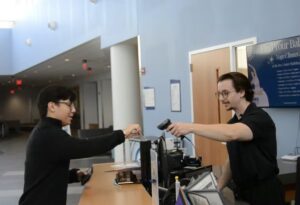
When Preeti Thakkar started working at the Foglia Foundation Health and Recreation Center at Harper College, she quickly learned why student employee onboarding matters. The Welcome Desk came with more than a checklist. There were memberships to understand, shifts to pick up, timecards to log, uniforms to wear correctly, and customer service expectations to meet. Hundreds of small details shaped how the CENTERS team served students, members, and guests each day.
Preeti has spent much of her Harper experience as a student employee. She first worked with the Wellness Department and later joined the CENTERS team at the Foglia Foundation Health and Recreation Center. She has now worked at the Rec for nearly two years. That experience shaped how she thinks about work, confidence, and career direction.
“I genuinely think that it has transformed me as a person,” Preeti said. “If students ever ask me for advice, I tell them, get a job on campus. It will change everything.”
That belief led her to a practical idea. Working with fellow student employee Santiago “Santi” Contreras, Preeti helped create a new onboarding video series that gives future student employees a clearer, more consistent start.
Building a Better Student Employee Onboarding Experience
The video series grew out of Preeti’s experience at the Welcome Desk. Although she had received training when she started, she also knew that some parts of the job only became clear when a real situation came up. That could put pressure on new employees, trainers, building managers, and professional staff.
Preeti wanted to create a standard baseline before new employees practiced on the job. The videos would support hands-on training rather than replace it. In addition, they would give every student employee access to the same information.
Frank Wawrzyniak, Assistant Director of Membership and Fitness Center Operations at Harper College’s Department of Campus Recreation, saw the same operational need.
“Consistent messaging and training cost reduction drove the idea for the videos,” Frank said. “We are a small team compared to other sites. We don’t hire enough new team members to hold regular onboarding trainings, so each professional staff member would handle basic instruction with their own team. Things would get missed. These videos ensure consistency.”
Preeti and Santi designed the series as a playlist of short training videos. To date, they have nearly completed the third video and plan to create four to five videos in total. Each segment covers one part of onboarding. Topics include orientation, workplace platforms, schedule and timecard procedures, communication expectations, customer service standards, and fire evacuation procedures.
Santi, who studies audio and video production and works on the marketing team at Harper Recreation, saw the value in that format.
As a result, the content became easier to absorb. Rather than asking new employees to sit through hours of training at once, the team created shorter segments that focused on the essentials.
Created by Students, for Students
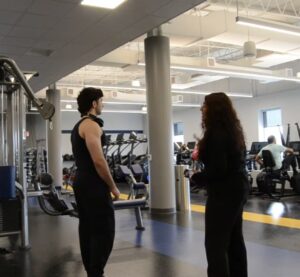
From the beginning, Preeti and Santi wanted the videos to feel professional, but not stiff. The series needed authority because it was training material. It also needed to feel approachable because the audience would be mostly student employees.
That balance shaped the creative direction. Students demonstrate expected behavior in the videos, which helps new employees see the job in practice. Screen recordings, B-roll, direct instruction, and workplace examples make the information easier to follow.
Santi focused on pacing and production. He wanted the videos to move quickly while still giving viewers enough time to understand the important points. In addition, he saw B-roll as a key part of the learning experience because it helped employees hear and see the information at the same time.
“The people in the videos are also students,” Santi said. “They can relate to it. They can be like, ‘I can be like them.’”
Preeti led much of the concept work. She developed the proposal, video ideas, scripts, and minor graphics. She also found a secondhand camera because she wanted the finished product to feel credible and professional. Santi helped bring the production side to life through filming, visual style, and execution.
“Preeti was in charge of the creation, and I was in charge of the execution,” Santi said. “You could have a great idea, but if you don’t execute it, it doesn’t exist.”
Trusting Student Employees with Real Work
The project gave Preeti and Santi real responsibility. For example, Frank did not assign it as a simple task or manage it step by step. He gave them direction, answered questions, and checked in. He also gave them room to lead.
“I gave Preeti the reins, and she delivered,” Frank said. “I was there to answer questions, but she set the meeting with our director to pitch the idea, including a budget outline. Since then, she and Santi have worked together every step of the way to get it done.”
For Preeti, the proposal process was a new experience. She had to explain the project, outline the goals, and connect the idea to training costs. She also had to show why the videos would be worth the investment. Then she and Santi had to produce the work while balancing classes, marketing duties, limited project hours, and team feedback.
The expectations felt different from a classroom assignment because the final product had to work for real people in a real workplace.
“In the classroom, you have your professor to guide you,” Preeti said. “But Frank was looking at us to make these videos. At the end of the day, it was on us to produce something and set the standard for what that vision was going to look like.”
That responsibility also changed how they worked. Preeti described learning how to manage a project from proposal to execution, respond to critique, and make decisions when something did not work as planned. She also practiced professional boundaries, including small but meaningful moments like asking people to move out of a shot so filming could stay on schedule.
Career Skills Through Student Employment
For both students, the onboarding video series connected directly to their career interests. Preeti is interested in graphic design, video production, branding, and advertising. Santi is focused on audio and video production, social media, and advertising. The project gave both of them portfolio experience that they can discuss in future interviews.
The project also helped them build broader career skills. For Santi, the major takeaways included real project experience, AI workflow, and ownership without micromanagement.
He saw AI as a practical tool that helped the team work faster while preserving time for creative decisions.
“AI is a tool, and you have to use it as a tool,” Santi said. “It helps us be more efficient, and then we have time to use our brains for key decisions.”
Preeti saw the work as part of a larger student employment experience. She found supervisors who expected students to grow while still understanding that they were learning. That balance helped her see student employment as a meaningful entry point into professional life.
“You get the best of both worlds,” Preeti said. “You have people to rely on and mentor you, but at the same time, they’re giving you expectations. You have something to work toward.”
A Stronger Start for the Students Who Come Next
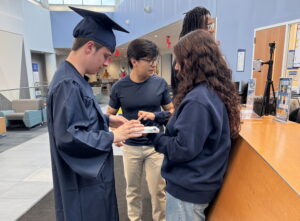 The onboarding video series will help future student employees at Harper Recreation begin with more clarity and confidence. The series will also give trainers a consistent resource, help professional staff reinforce expectations, and give students a place to return when questions come up.
Ultimately, the project’s impact reaches beyond onboarding. It shows how student employment can become a setting for leadership and career readiness when students receive trust and support. It also reflects the culture of the CENTERS team at Harper College. Student employees are encouraged to bring ideas forward and shape the work around them.
Santi described the Rec as a place where students gain professional experience and build community. Preeti described it as a place where students form meaningful connections with coworkers, mentors, and patrons.
Together, they created a resource that will support the next group of student employees. In the process, they also showed what student excellence can look like when students are trusted with real work, given room to grow, and encouraged to make the experience better for the people who come after them.
 About the Author