
INSIGHTS
As funding pressures grow, external event revenue must make a more dependable financial contribution.
Many institutions once treated revenue from external conferences, events, and facility rentals as financial upside. Success looked like a full calendar, strong attendance, and a few marquee events that generated meaningful revenue. Those wins created energy and visibility, but institutions did not necessarily need to rely on them from one year to the next.
The financial assumptions are changing. Across many of the CENTERS managed campus operations, external (non-university) revenue is a high priority. What many once called speculative revenue is becoming realized revenue on many campuses. Institutions are building it into the operating budget and relying on it to support ongoing operations, investment, and financial stability.
Broader market conditions explain the shift. Inflation-adjusted net tuition and fee revenue per full-time-equivalent student at public institutions declined 3.5% in fiscal year 2025 and has fallen in four of the past five years, according to the State Higher Education Executive Officers Association. Private institutions face their own pressure with estimated tuition discount rates exceeding 50% for both first-time and all undergraduates. In NACUBO’s 2025 survey of more than 600 college and university business officers, unreliable funding, increasing operating costs, and workforce limitations ranked among their most significant concerns.
External event revenue cannot fully compensate for pressure on tuition revenue, appropriations, or philanthropy. It can, however, offset some of that pressure and provide an increasingly necessary source of funding for ongoing operations and investment.
A Higher Standard for Revenue Performance
Institutions need external events to produce a meaningful financial contribution consistently enough to rely on that revenue year after year. Doing so requires clear answers to three questions:
- Which opportunities produce a meaningful contribution after the full cost of delivery?
- Which events and audiences can the market support consistently at an appropriate level of risk?
- How should the event portfolio support the institution’s priorities and role within the broader market?
Answering those questions requires an operating paradigm aligned with strategic objectives. External event activity often spans Conference and Event Services, athletics, recreation, student centers, arenas, academic units, and campus support functions. One integrated system must connect pricing to delivery costs, booking and marketing to audience demand, and staffing to the operational requirements of the business being pursued.
Alignment with the institution’s mission and financial expectations reduces risk and organizational friction. It also establishes clear authority, consistent decision criteria, and accountability across the event portfolio.
CENTERS creates and manages that operating paradigm, whether we lead a centralized event operation or work across an existing network of campus stakeholders.
Understand the True Economics of Campus Events
Predictable revenue starts with a clear understanding of event margins. Rental rates and gross revenue show only part of the picture. Leaders also need visibility into the full cost structure, including labor, equipment, audiovisual support, security, housekeeping, marketing, and other resources used to deliver each event.
Event-level financial data informs far more than pricing. It helps the operation set margin expectations, identify the most profitable event types and customers, and focus sales and marketing on the highest-yield markets. Over time, those choices build a stronger mix of business and improve the institution’s ability to forecast results.
CENTERS applied this approach within Conference and Event Services at Cleveland State University. In the first full fiscal year under CENTERS management, the operation more than doubled year-over-year revenue and achieved its first positive operating result.
See CENTERS in Action at Cleveland State University, featuring insights from Executive Director Nick Froelich on how the team turned event economics into better operating decisions.
Build a Campus Event Calendar Around Market Demand
A sustainable calendar begins with a realistic view of the market. Audience size, regional demand, venue capacity, event costs, and financial exposure determine whether a booking can deliver repeatable value.
Strong programming combines local audience knowledge with broader market intelligence. Teams can use those insights to assess individual bookings, balance financial risk across the calendar, and select an event mix suited to the venue and community. A focused calendar also gives marketing a clearer assignment and a more defined audience to reach.
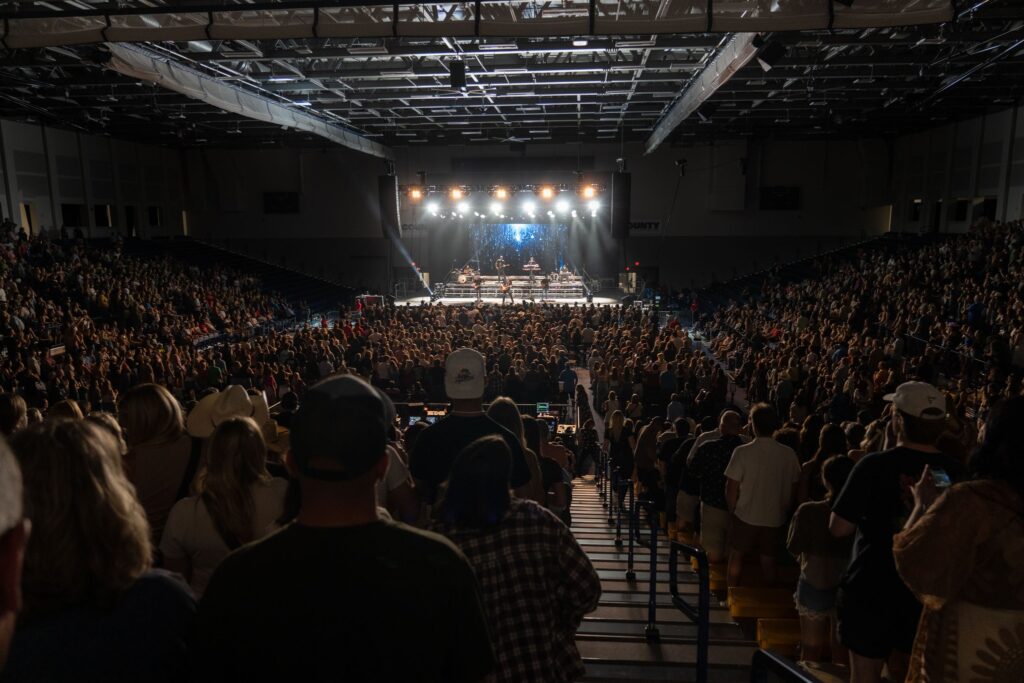
At Longwood University’s Joan Perry Brock Center, CENTERS combines national booking knowledge with local operating intelligence to build a calendar suited to the venue and its small market. The team evaluates each opportunity against the arena’s reachable audience, capabilities, and risk profile. Those decisions balance financial opportunity with Longwood’s use of the arena to support recruitment, brand building, and other institutional priorities.
Read CENTERS in Action at Longwood University, featuring insights from General Manager Craig Stover on building a viable audience in a small market.
Align Campus Venue Strategy With the Broader Event Market
Every venue operates within a larger network of campus priorities, facilities, calendars, community needs, and market offerings. A clearly defined role helps leaders decide which opportunities the venue should pursue, where it can complement existing activity, and when partnerships can expand its impact.
Leaders need an institution-wide and market-wide view. Conference and Event Services, athletics, recreation, student centers, academic units, campus support functions, and community partners may all influence the event portfolio. Shared strategy, decision authority, financial expectations, and performance criteria allow those stakeholders to act within one integrated management system.
The developing event strategy for the Sonnentag Center at the University of Wisconsin–Eau Claire reflects this broader view. The team is building a calendar around athletic tournaments, community-facing events, and the facility’s place within the Eau Claire market. Collaboration with the Pablo Center at the Confluence can help the two venues identify complementary entertainment opportunities, while a partnership with Visit Eau Claire expands access to the youth sports tourism market.
From Speculative Revenue to Dependable Contribution
A dependable contribution comes from disciplined event economics, a calendar grounded in viable demand, and a clear understanding of how each venue fits within the institution and its broader market. The right strategy will vary, but every institution needs an operating paradigm that connects those decisions and establishes accountability for performance.
CENTERS creates and manages that integrated system. We align the people, capabilities, and operating decisions behind external events so institutions can turn individual opportunities into revenue they can rely on. As institutions rely more heavily on that revenue to support ongoing operations and investment, effective event management becomes an essential component of the institution’s financial strategy.
Sources and Further Reading
- State Higher Education Executive Officers Association. “State Higher Education Finance: FY 2025.” 2026.
- National Association of College and University Business Officers. “Most Undergraduates Receive Grants at Private Colleges, NACUBO Research Shows.” June 1, 2026.
- National Association of College and University Business Officers. “Funding Uncertainty Leads NACUBO’s Top 5 Higher Education Business Issues of 2025.” September 8, 2025.