
How professional management strengthens student centers, recreation facilities, and campus events
Walk through any well-run student center or campus recreation facility, and the experience feels seamless. Students gather comfortably. Multiple events proceed simultaneously without disruption. Spaces remain clean, safe, and ready for use. The entire environment appears calm and self-sustaining, like a swan gliding effortlessly across the water.
But institutional leaders understand that the most stable systems often look effortless only because of the deep operational work happening beneath the surface. What appears simple from above requires complex coordination below. Facilities do not run by themselves. Programs do not shape themselves. Student workers do not develop themselves. The operational and developmental infrastructure that supports a positive student experience is almost always hidden from view.
As a partner dedicated to professional facility and program management, CENTERS absorbs the unseen workload that makes visible excellence possible. While students and employees experience polished outcomes, the institutional leaders benefit from a partner managing the operational depth that shapes campus satisfaction, safety, and success.
The Operational Infrastructure Behind Successful Campus Facilities
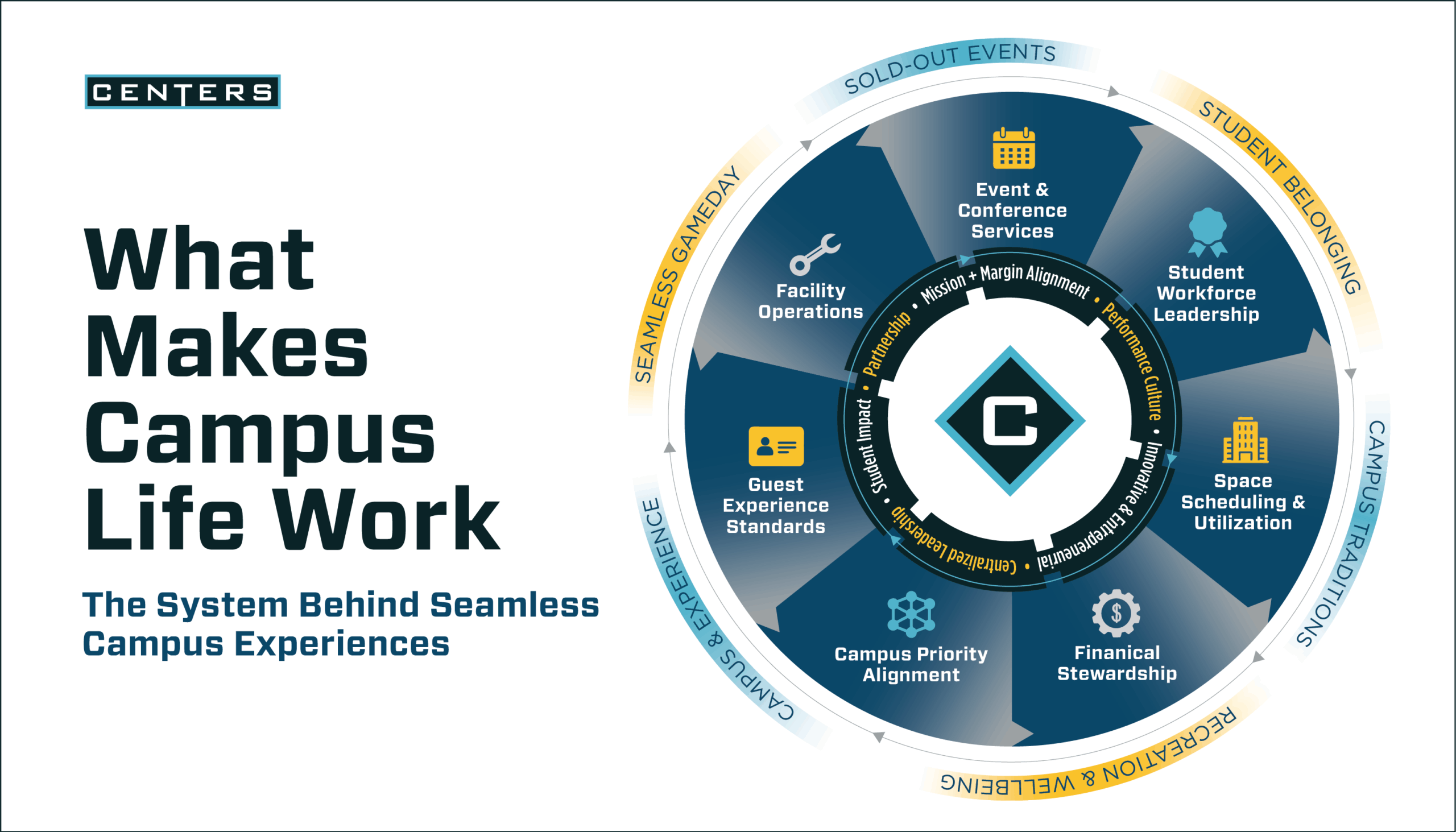 From an executive vantage point, facility operations are mission-critical. They shape student impressions, influence retention, and affect institutional reputation.
Student unions, recreation centers, wellness facilities, and multipurpose hubs are often viewed as simple, open access resources. Students walk in expecting the lights to work, the equipment to be functional, the rooms to be available, and the environment to feel safe and comfortable. The assumption is that these spaces “just run.”
For a campus community of thousands, even the smallest disruption can ripple outward. A malfunctioning treadmill, an unscheduled closure, or a double-booked meeting room, can diminish the student experience or erode institutional confidence.
CENTERS brings professional operational discipline that ensures reliability. Our teams protect institutions from the cascading effects of small disruptions. As a result, they create conditions for an atmosphere that feels comfortable and predictable. To the campus community, everything looks steady. Beneath the surface, CENTERS powers the systems that keep it that way.
Developing Student Employees Through Structure Leadership and Training
Most institutions rely heavily on student employees to support building operations and program delivery. As desk attendants, building managers, lifeguards, event staff, supervisors, and community stewards, their work is highly visible. What remains invisible is the complexity of the responsibilities placed on their shoulders and the developmental infrastructure required to prepare them for those responsibilities.
Effective student employment provides more than part-time labor. It has become a high-impact learning experience. Students acquire skills associated with early career roles. They learn risk management, customer service, teamwork, communication, and incident response. These jobs often represent a student’s first encounter with real professional accountability and performance expectations.
This learning only happens when an intentional structure supports it. CENTERS designs that structure. Professional staff create comprehensive training programs, provide consistent supervision, reinforce expectations, and ensure that every student worker receives guidance aligned with industry standards.
The visible outcome is a confident student workforce. The invisible reality is a carefully engineered framework designed to foster growth while maintaining operational excellence. In practice, this means professional staff across all career levels are trained in people leadership, foundational student development theory, and program planning.
Managing Risk and Complexity in High Visibility Campus Events
Public-facing campus events often shape community perception more than almost any other activity. The guest experience must be smooth and coordinated, but this surface-level polish is only possible through significant planning.
Crowd management, equipment safety, weather considerations, vendor oversight, compliance with institutional policies, and emergency readiness each require professional attention.
CENTERS brings professional event management expertise to every facility in its management portfolio. The result? More dynamic events with fewer disruptions and safer outcomes for the entire campus community. Risk management practices are embedded across CENTERS operations.
This includes training for all staff, role specific preparation for emergency response, insurance coordination, operational standards, and company led internal audits of site operations. Managing risk remains a permanent fixture of CENTERS client solutions.
Professional Staff Who Mentor, Coach, and Scaffold Student Success
Among third-party partners in higher education, the depth of developmental support can vary widely. Many external providers focus almost exclusively on task execution. CENTERS approaches its work differently. Our model positions professional staff as educators as well as operators. This distinction is one of the organization’s defining advantages.
CENTERS invests heavily in student leadership pipelines, structured training curricula, ongoing professional development, and real-time coaching. Professional staff guide students through complex situations, support performance improvement, and remain available during after-hours incidents that require judgment and experience.
This commitment to mentoring is not incidental. It is a core component of the CENTERS philosophy. Executive leaders benefit from this model because it strengthens student success, builds workplace readiness, and elevates the quality of operations simultaneously.
In short, the institution receives both strong operational performance and meaningful learning outcomes. Few partners can effectively deliver both.
A Strategic Partner Supporting Institutional Focus and Stability
For senior leaders, the campus environment is a direct reflection of institutional priorities. When facilities run smoothly and programs thrive, the institution appears stable, student-centered, and professionally managed. When disruptions occur, leadership attention is pulled away from strategic work and redirected toward operational troubleshooting.
CENTERS ensures that the campus environment supports the institution’s broader goals. Professional systems allow administrators to remain focused on enrollment, academics, budgeting, and long-range planning rather than daily operational strain.
Students benefit from consistent service. Staff benefit from reduced workload pressure. Leadership benefits from confidence in a partner that handles the complex, unseen activity that sustains the campus experience.
The campus community sees the swan gliding. CENTERS manages the movement beneath the surface that keeps the entire system balanced, coordinated, and strong.
For institutions seeking visible excellence supported by operational depth, CENTERS provides a partner aligned with the expectations of higher education leadership.
 Joanna Prociuk serves as Assistant Vice President of Talent and Innovation at CENTERS, where she leads initiatives focused on recruiting, developing, and supporting the professionals who operate campus life facilities across the company’s portfolio. A strong advocate for student development and operational excellence, she previously served as Director of University Recreation at Jacksonville State University and began her CENTERS career as a student employee at DePaul University’s Ray Meyer Fitness and Recreation Center, the company’s first managed site. Joanna frequently presents at NIRSA and Athletic Business on topics including student leadership, facility operations, and workforce development. She holds a bachelor’s degree from DePaul University and a master’s degree from the University of West Florida.