
How B&D and CENTERS Are Building a Unified AI Ecosystem
 When a new technology starts reshaping an entire industry, the instinct is often chasing the flashiest tools. But real, sustainable innovation doesn’t start with tools. Enterprise AI ecosystem development starts with structure, data systems, repeatable workflows, and clear goals.
That’s the approach behind the AI work happening across B&D and CENTERS. Rather than simply experimenting with what’s new, we are intentionally building an intelligent, secure, and practical foundation that supports how our people actually work, both today and in the long run.
What began as separate AI explorations on each side of the organization has evolved into a coordinated, growing ecosystem. The goal isn’t uniformity for its own sake. It’s smarter knowledge sharing, clearer alignment, and tools that help people work better, not just faster. Because we all know, better is better.
Enterprise AI Ecosystem Development Takes a Shared Push
Like most innovation journeys, ours started with curiosity. A few people testing ideas. Spotting potential. Pulling threads.
On the B&D side, it was clear early that AI wasn’t just another passing trend. The pace of change alone made one thing obvious. Waiting would only make it harder to catch up later. AI was going to be transformative for our industry, and staying ahead of that curve became a strategic priority.
At the same time, CENTERS was developing AI resources and training focused on ethics, literacy, and real-world applications. Different starting points, but similar goals. Increase efficiency, strengthen output, and build responsible fluency across the organization.
That parallel motion became a shared push in November 2024 with the formation of the CENTERS AI Council. By design, the Council included both CENTERS and B&D leaders. That structure mattered. It turned independent efforts into a unified one.
Knowing there was a dedicated group within CENTERS that was ambitious and engaged in advancing skills and capabilities companywide allowed us to take more intentional technological risks. That support made it possible to pilot new programs, generate use cases, and maintain momentum as we iterated on better options for our AI strategy and tooling.
Sonic: A Practical Tool with Big Reach
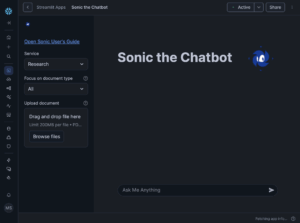 Sonic is B&D’s internal AI assistant. It is a secure, proprietary resource designed to support project teams across the firm. From day one, it was built with structure and control in mind.
It doesn’t scrape the internet. It pulls from curated, permissioned documents housed in our internal Snowflake environment, working in conjunction with Microsoft Azure for storage and data management.
The primary use cases are straightforward and highly practical. First draft support, ideation, and early-stage writing across multiple document types.
Today, Sonic draws from more than a million internal documents, helping teams research, draft, and refine work more efficiently and consistently. Ongoing efforts to enhance Sonic are an essential part of our evolving technology pipeline. We are excited about a Microsoft Teams plugin currently in testing, which will bring Sonic directly into the tools our teams already use every day.
Looking ahead to 2026, Sonic will evolve in two important ways:
- Expanded Content – Incorporating more CENTERS-specific materials like planning standards, consulting models, and operational protocols.
- Automation – Creating a structured pipeline between SharePoint and Sonic to streamline how new content is ingested and updated.
The payoff is tangible. Faster onboarding, stronger first drafts, smoother site launches, and better foundations for client work. All supported by higher-quality AI responses tuned to real business needs.
A Two-Way Knowledge Loop
While B&D has led the development of proprietary tools like Sonic, the broader AI ecosystem is intentionally shared, and much of that credit goes to CENTERS’ early leadership in training, governance, and responsible use.
CENTERS has consistently pushed us to improve documentation, adoption processes, and internal behaviors. That track record has given us a strong playbook to learn from, refine, and scale.
One shared initiative now in development is a set of training-focused AI agents. These internal resources could guide new employees through topics such as operations, consulting protocols, project close-out, or proposal standards.
The goal isn’t to turn people into checklists. It’s to reinforce consistency while preserving judgment, creativity, and expertise.
We also take a balanced approach to tooling. Off-the-shelf platforms help us understand what’s possible. Internal tools help us understand what we don’t need to buy because we can build solutions better suited to specific workflows.
Built on Guardrails
Security and governance weren’t added later. They were baked in from the start.
Sonic runs on internal models, with structured, filtered content and tiered access based on role, relevance, and permissions. Proprietary data stays in our ecosystem, protected at multiple layers of the infrastructure.
Responsible use isn’t just a policy issue. It’s a design principle. The goal is to give teams freedom to use AI meaningfully without introducing new risks, compliance challenges, or trust gaps.
Growth That’s Innovative and Practical
Our AI roadmap is ambitious, but it’s also grounded. We’re not chasing tools that look great in demos and fall apart in practice. We’re building for repeatable, scalable value.
Smarter workflows. Faster learning. Stronger outputs. Better service to our clients.
Real progress is not measured by how many AI tools we deploy. It is measured by how the organization grows through them.
By strengthening our shared knowledge base, empowering our teams, and staying ahead of industry shifts, enterprise AI ecosystem development at Brailsford & Dunlavey and CENTERS is becoming something bigger than individual tools. We’re building an AI-forward organization.
That’s what we mean by bridging intelligence. Not just having AI…
But building an ecosystem makes it matter.
 Chris McCay serves as Vice President for Corporate Infrastructure at Brailsford & Dunlavey, where he leads enterprise technology strategy and oversees information technology for both B&D and its wholly owned subsidiary, CENTERS. A member of the CENTERS AI Council, Chris plays a key role in shaping the shared AI infrastructure, governance, and security framework that supports responsible adoption across the organization. With more than 20 years of experience in information technology and over a decade at B&D, he has guided major infrastructure advancements, including hybrid cloud environments and secure enterprise systems.