
How HIWA at the University of Auckland Connected Wellness, Data, and Academic Outcomes
 A Decade in the Making
More than a decade ago, the University of Auckland engaged Brailsford and Dunlavey and its operating arm, CENTERS, to develop the program, design criteria, and business case for a new recreation center. In a national higher education environment cautious about institutional borrowing, the project would take years to move from planning to approval to construction.
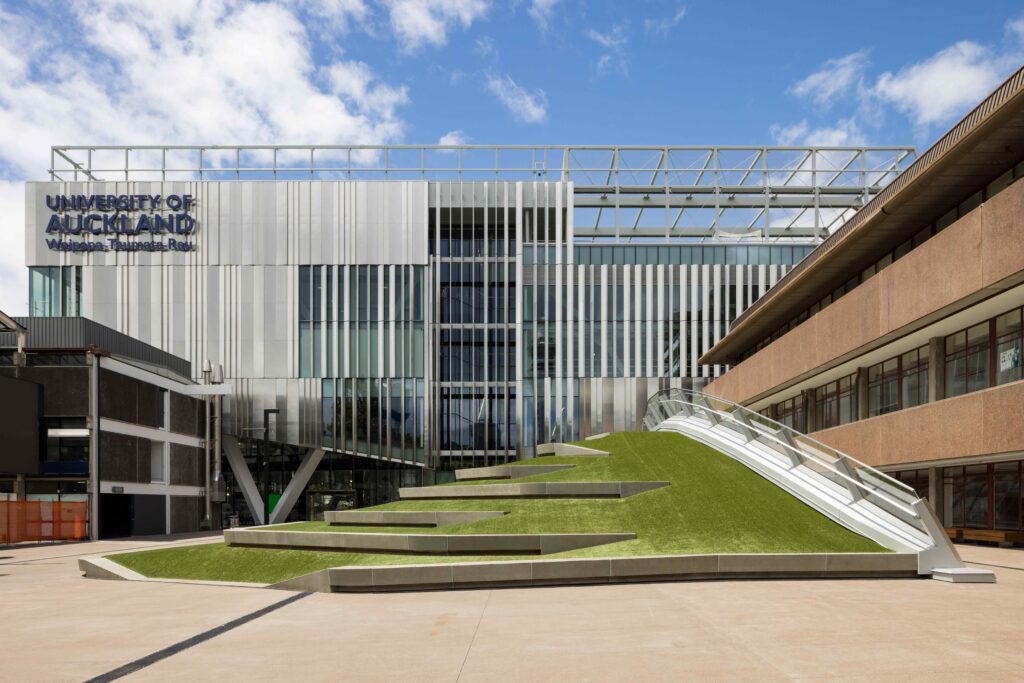
That project ultimately became the HIWA Recreation Centre at the University of Auckland, a purpose-built environment designed to support student wellbeing, belonging, and campus connection. HIWA officially opened on November 25, 2024, replacing a recreation center that had served the University since the 1970s. Within its first year, the facility recorded more than 900,000 visits. The figure far exceeded early projections and underscored what planners had argued for years: the previous facility could no longer meet campus demand.
The new center spans approximately 26,000 square meters (nearly 280,000 square feet), rising vertically on the precise footprint of its predecessor. It has since earned national and international recognition, including the Sport Architecture category award at the World Architecture Festival 2025, the IOC IAKS Architecture Prize, the Supreme Excellence Award from the Property Council of New Zealand, and honors at the 2025 New Zealand Architecture Awards.
However, HIWA’s significance lies less in its size or public acclaim than in the decade-long discipline behind it. From the outset, the University integrated recreation center planning into its academic and strategic objectives.
The University of Auckland campus sits within a dense urban environment, leaving little room for physical expansion. The previous recreation center, constructed in the 1970s for a campus of roughly 10,000 students, was serving more than four times that number by the 2010s. The building was aging and had not been consistently maintained during periods when it was operated by the student association.
Leadership and Institutional Commitment
 Brendan Mosely, Director of Campus Life at Waipapa Taumata Rau, University of Auckland, understood the stakes of that transition personally. As a first-generation university student, he has written about feeling uncertain and disconnected during his early years on campus, unsure how to navigate university life or where he belonged.
Those experiences would later inform his approach to campus life strategy. During the 12-year process of developing HIWA Recreation Centre, Mosely and his team framed recreation not simply as physical infrastructure, but as a vehicle for belonging, persistence, and academic success.
He recalls the condition of the former facility clearly. “It was falling apart,” he said. “But it was right in the heart of the student sector of campus. So, it was much beloved.”
Replacing the aging facility required more than renovation. In New Zealand’s debt-cautious higher education environment, leadership needed a defensible business case and sustained executive support. Mosely ended up personally writing much of it.
“It was $330 million,” he said. “I had to do quite a lot of work with senior leaders, decision makers, and board members, to get that over the line.” The approval, he said, was the defining moment.
“Getting the approval on the business case was the moment for me where I thought, ‘okay, that’s done,’” he said. “For a leader in my position, once that’s done, you know it’s just going to happen. There’s a natural workflow.”
Designing Within Constraint
The University of Auckland’s urban campus offered little opportunity for horizontal expansion. As a result, HIWA would need to rise vertically, carefully integrated within an already dense urban campus.
Mosely described the design constraints as intense. “What we ended up doing was completely maximizing the site,” he said. “It’s a stacked facility, six floors above ground, two below. We’re bounded on two sides by roads, including a major arterial, and on the other two sides by existing buildings.”
The margins were narrow. “We’re talking centimeters,” he said. “Can we push this one centimeter further toward the science building, or are we going to undermine it?”
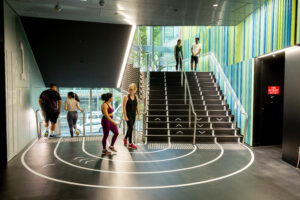 The result is a compact vertical design that integrates fitness, aquatic space, studios, and social areas within a tightly constrained footprint. A rooftop running track, framed by views of Auckland’s skyline, has become one of the center’s most distinctive features.
During construction, some questioned whether the building was too large for campus demand.
“Everyone else in the university was telling me I was mad, that it was way too big,” he said
Some compromises were inevitable. “We just couldn’t fit everything in,” Mosely said. “In other words, we got 95 percent of what we wanted.”
What they did secure was extensive: a competition pool and leisure pool, sauna, squash courts, rock climbing wall, indoor and outdoor running tracks, rooftop turf, and two full-sized courts, including one with an LED glass floor that allows markings to be changed digitally.
“We were really pleased that we got everything we wanted,” he said.
Importantly, early usage data validated that sentiment quickly. First-year visitation figures and consistent daily traffic patterns confirmed that the scale reflected need rather than excess.
Recreation Center Engagement and Academic Outcomes
The business case for HIWA rested in part on research linking campus engagement to student persistence and academic performance. At Auckland, leaders examined those assumptions locally through data collected over time at the recreation center. “I looked at the academic performance of our recreation centre members versus non-members,” Mosely explained.
The analysis extended beyond a single moment. Data were tracked across the former facility, through an interim temporary site, and now within HIWA itself. “We have nearly perfect data,” Mosely said, noting the consistency of participation tracking and academic comparison.
The patterns were clear. Recreation center members demonstrated stronger academic outcomes and higher retention rates than their non-member peers. The differences were particularly pronounced among Māori and Pasifika students.
“Recreation centre members have grades and retention rates… and for Māori students, Pasifika students, the difference is even more pronounced,” he said. For Pasifika students specifically, membership correlated with significantly higher rates of A grades.
The findings did not create belief; they clarified it. “It was all intuitive and emotional,” Mosely acknowledged. “But having that data really helps when someone says, okay, sign here for $330 million.”
In this respect, HIWA reflects a broader institutional evolution: recreation centers positioned not as peripheral services, but as contributors to academic strategy, equity outcomes, and measurable student success.
Beyond a Gym: A Campus Commons
From its earliest planning stages, HIWA was conceived as more than a fitness facility. “It’s a recreation and wellness centre. It’s not a gym,” Mosely emphasized. “The emphasis was always on recreation and connection.”
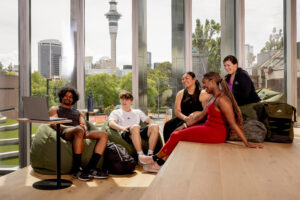
Design decisions reinforced that philosophy. Social seating areas sit alongside activity spaces. Circulation paths provide visual openness. Informal study, structured programming, and spontaneous gathering coexist within the same environment. “The barrier to entry is really low, and that’s deliberate,” he said.
Students responded accordingly. The recreation center became part of the daily rhythm of campus life. “Students will turn up in the morning… they’ll sit down there and do some study, then they’ll go work out, then they’ll go to the café, come back,” Mosely observed.
In practice, HIWA began functioning as a student commons, a place where academic life, physical activity, and social connection intersect. “It’s a home base for them,” he said.

At the same time, the facility was designed to serve a broader spectrum of users. HIWA accommodates high-performance sport and competitive teams alongside informal recreation. The center has already hosted elite groups, including French national rugby team, the Silver Ferns, and the Kiwis NZ Rugby League side, underscoring its capacity to support serious athletic preparation as well as everyday student engagement.
For the University, that dual role is not incidental. “This really is our only sporting infrastructure,” Mosely noted.
In a dense urban campus without expansive athletic fields or standalone arenas, HIWA carries institutional weight. It functions simultaneously as a student gathering place, a training environment, and a visible commitment to student wellbeing and performance.
Managing Success and Preserving Intent
Recognition and high usage introduced new operational pressures. Demand for special events and external partnerships expanded rapidly. As a result, leaders implemented disciplined governance to preserve the center’s student-first mission.
“We can only accept 10 percent of requests for special events,” Mosely noted. “There’s a huge amount of work in the 90 percent of inquiries that you’re saying no to.”
The attention extended beyond scheduling. The same recreation leadership team that had stewarded the project through planning and an interim facility now operates HIWA at scale. That continuity provided stability, even as early demand and external visibility quickly intensified.
“That’s probably something we could have done better,” Mosely reflected, “getting the team set up with the resources to handle that attention.”
Nevertheless, the discipline that shaped the planning process continued to guide operations. “At every juncture where we had to make a difficult decision,” he said, “we had that data to back it.”
Institutional Alignment as Enduring Strategy
HIWA’s early success, evidenced by first-year participation, international recognition, and sustained student adoption, affirms the strength of its design. More importantly, its deeper significance lies in how thoughtful recreation center planning aligned with academic priorities, supported data-driven operations, and connected to impactful student outcomes.
“Really understand what you need,” Mosely said. “It’ll be unique. No one else will have it. Possibly no one else will want it. And it doesn’t matter… It’ll be the best in the world for you.”
For institutions considering new recreation centers or major wellness investments, HIWA offers a reminder: when planning is grounded in evidence and institutional clarity, these facilities can become foundational infrastructure for student success.