
How Carissa Short is using AI to elevate training and leadership
“We currently use AI within intramurals to practice conflict management a couple of different ways.”
“AI has allowed me to create more structure and more personalized experiences for my staff.”
Those two ideas sit at the heart of how Carissa Short, Coordinator of Recreation Sports at the University of Missouri–St. Louis, is using artificial intelligence to change the way student staff learn, grow, and serve. AI training in campus recreation programs is already reshaping how student staff learn, lead, and perform, and UMSL is setting a clear example. Rather than treating AI as a shortcut or a novelty, Carissa has embedded it directly into the systems that support her people.
 AI Training in Campus Recreation Programs That Feels Real
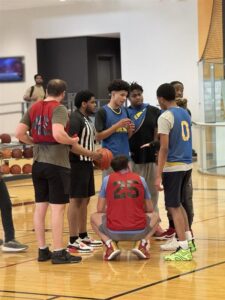
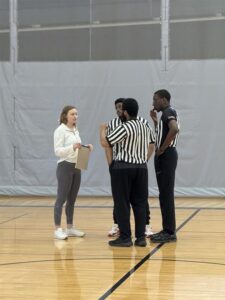
Conflict is one of the most demanding parts of intramural sports. Officials must make fast decisions while navigating emotion, competition, and high expectations. At UMSL, AI has become a training partner that allows staff to practice these moments before they ever step onto the court. Officials work through AI-generated scenarios to practice key phrases and de-escalation strategies. They also interact with AI personalities through typing or voice, allowing them to rehearse real-time conflict resolution in a controlled environment. When a phrase does not feel natural, AI helps reword it so staff can follow best practices while still sounding like themselves.
Two participant profiles have become especially valuable in these simulations. The “Friendly but Clueless player” is enthusiastic but unfamiliar with the sport, often becoming frustrated when fouls add up. AI helps staff practice explaining rules in beginner-friendly ways, rephrasing concepts, and building patience. “The Sports Hopeful” is highly competitive, knowledgeable, and not afraid of confrontation. These interactions can feel aggressive and overwhelming for new officials. AI allows staff to practice confident communication and key phrases for de-escalation so that when these situations arise, they already know how to respond. The result has been a noticeable increase in staff confidence and preparedness. Officials enter games with a foundation already in place, allowing them to grow faster and perform more effectively under pressure.
Turning Rule Clarity into a Competitive Advantage
Rules are one of the most common sources of conflict in intramural sports. Players bring expectations from high school, college, and professional leagues, and confusion often leads to disputes. Carissa utilized AI to simplify and streamline UMSL’s rule books and policies, making them easier to understand and apply. By removing redundancies and clarifying language, officials can learn more efficiently and communicate rules with greater confidence. That confidence translates directly to players, creating trust and reducing conflict from night one.
Developing Leaders, Not Just Employees
AI has also become a cornerstone of leadership development at UMSL. Carissa uses it to build customized leadership strength assessment checklists that account for each student’s position, cross-employment, and academic workload. Both the student and supervisor complete the checklist, then review it together to identify strengths, growth areas, and next steps. Scenario-based questions generated through AI help connect leadership competencies to real intramural situations. This allows students to see how what they are learning applies to their daily work and their long-term goals, making development more meaningful and more actionable. As a result, student leaders are working more independently, thinking more critically, and delivering stronger customer service across the program.
Technology That Deepens Human Connection
For Carissa, AI is not about replacing people. It is about strengthening the systems that support them. By making training, feedback, and development more personalized, AI has led to deeper conversations and stronger relationships between supervisors and staff. What has been most surprising is how AI has sparked new ways of thinking. The prompts and perspectives it provides often open the door to conversations and insights that might not have happened otherwise.
 Setting the Bar for What Comes Next
After seeing success in intramurals, Carissa plans to extend AI into other areas she oversees, including the climbing wall and summer camp. While people will always be at the center of programming, AI can enhance training, customer service, and efficiency by making existing systems more individualized and effective. Her advice to other campuses is simple. Stay open to experimenting. The more teams are willing to explore and refine how they use AI, the more value it brings to their programs.
“Programming will always require people,” Carissa has said, “but AI can greatly enhance our offerings, customer service, and staff training by making our systems more individualized and efficient.”
Through leaders like Carissa Short at UMSL, AI training in campus recreation programs is becoming a new standard for how technology and people work together. This is what innovation looks like when it is grounded in real teams, real challenges, and real results.
 About the Author